Weasel McCarthy
Three Bags FullWeasel McCarthy is the dead man found beneath a shifting layer of pebbles, and his concealed body turns a discovery into a murder inquiry. George recognizes that the death was unnatural and suspects a coordinated cover-up connected to The Mad Boar; later, George's flock interprets the killing as the reason George left them. McCarthy matters less here through a known biography than through the secret his body brings to the surface—and the uncertainty that remains about who killed him.
Discovery and Identification
As Melmoth and George uncover a large body, stones slide away from it; the butcher identifies the dead man as Weasel McCarthy. George has been tugging grimly at a leg, and the exposed body has a thin torso and thin limbs set at odd angles. Its face is described as surprised and dead, while George observes that the body is stiff. The details establish the physical fact of death but do not, by themselves, disclose how it occurred.
Melmoth could have escaped after the body appeared, but he is too tired and remains silent as night gives way. The dogs sniff curiously at McCarthy. George bends over him, and Ham, who does not come closer, suggests fetching the police. The scene therefore begins with a straightforward response to a corpse, but George's recognition that the death was not natural immediately changes its direction.
George's Murder Theory
George calls McCarthy's death a real murder and asks Ham to think about who might have had a reason to kill him. When the butcher urges them to go to the police, George insists that they first consider the larger danger: McCarthy's identity, he argues, connects the body to a broad set of possible suspects. He names Josh, Sam, Patrick, Gerry, Michael, Healy, Eddie, Dan, Brian, O'Connor, Sean, and Nora. Ham questions whether the suspicion could include everyone, including O'Connor and Fred; George answers that he does not know exactly who carried out the killing.
George's theory is that the crime involved a group rather than a single readily identifiable attacker. He believes that people who had been at The Mad Boar the previous day were collectively implicated, perhaps along with others, and that the person directing events may have stayed away from the pub. In his reconstruction, McCarthy was hidden, while a story that he had been at the pub was allowed to circulate. If his body were discovered later, George reasons, the uncertainty about when he died would give the suspects useful alibis: subsequent appointments, legal consultations, or trips to town could help account for their movements. These are George's suspicions, not a confirmed account of the murder, and the killer remains unidentified in this evidence.
What the Death Means to the Flock
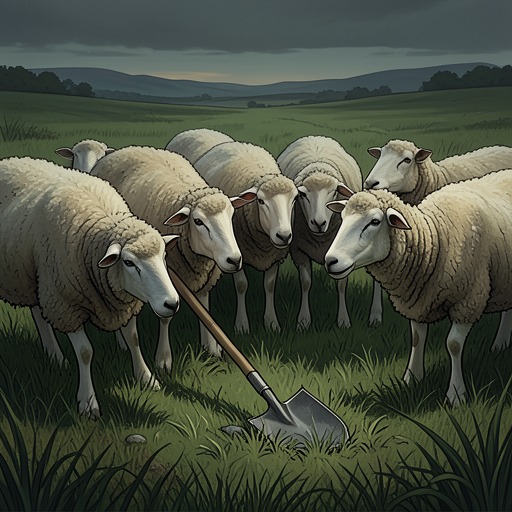
After Melmoth has gone, George's flock gathers and listens to Miss Maple investigate. She concludes that George left because he discovered that his own flock had killed McCarthy. Her comparison recasts the human conspiracy through the flock's understanding of animals: a familiar group can turn out to contain wolves disguised as sheep, indistinguishable by scent. In that reading, the concealed body is not simply evidence of an individual death; it is the secret that reveals the moral character of the group around George.
Miss Maple distinguishes that discovery from an escape. She thinks the point was for the truth to get out, which she identifies as what humans call justice. McCarthy's murder thus becomes the hidden cause the flock assigns to George's departure and the focus of a larger question about collective guilt and exposure. The interpretation gives his death a consequence beyond the murder investigation, while leaving the central factual uncertainty intact: George suspects a conspiracy, but no particular murderer is named.